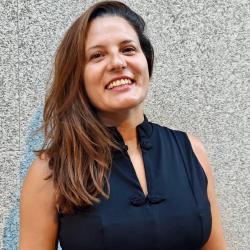
Dr. Eugenia San Segundo
Tenured Scientist at CSIC Madrid
About me
I am a Tenured Scientist in Experimental and Applied Phonetics at the CSIC, and Director of the CSIC Phonetics Laboratory. I currently lead the research project WAV: The WAves (and wrinkles) of our Voice and serve as Editor-in-Chief of the journal Loquens.
Research trajectory
Internationalization
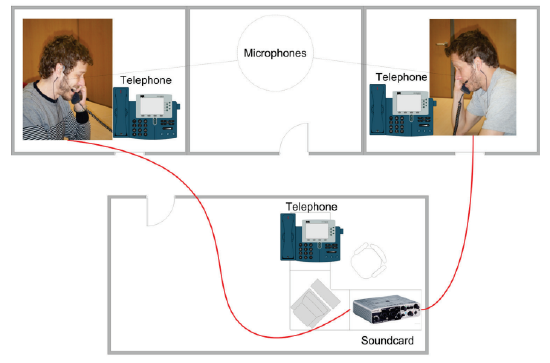
I have completed three research stays in renowned phonetics labs: at the University of Marburg (2012), the University of Zurich (2017), and the National Institute of Informatics in Tokyo (2025). In Marburg, I developed an important section of my dissertation: the analysis of identical twins’ voices using an automatic speech recognition (ASR) system. In Zurich, with funding from the Swiss National Science Foundation, I made key scientific contributions to the study of rhythm and prosody, which resulted in several publications and conference presentations. More recently, in Tokyo, with funding from the Spanish National Research Council (CSIC) through its Ayudas para la Incorporación de Científicos Titulares programme, I conducted an experiment on human perception of voice deepfakes. This research has led to a recent co-authored publication with researchers from the Japanese institution, as well as several conference presentations.
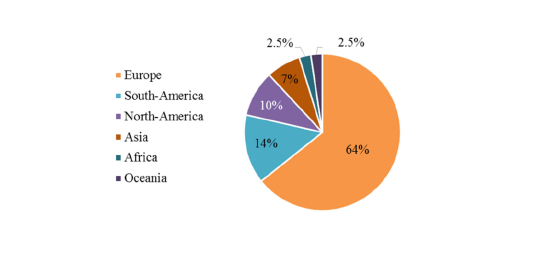
I have been a member of the International Association for Forensic Phonetics and Acoustics (IAFPA) since 2010. I have also organized its annual conference twice and twice received funding through its annual call for pilot research projects: in 2011, to study the voices of twins, and in 2016, to investigate voice quality practices. In addition, I have given around 20 invited talks in 10 different countries
Outreach and knowledge transfer
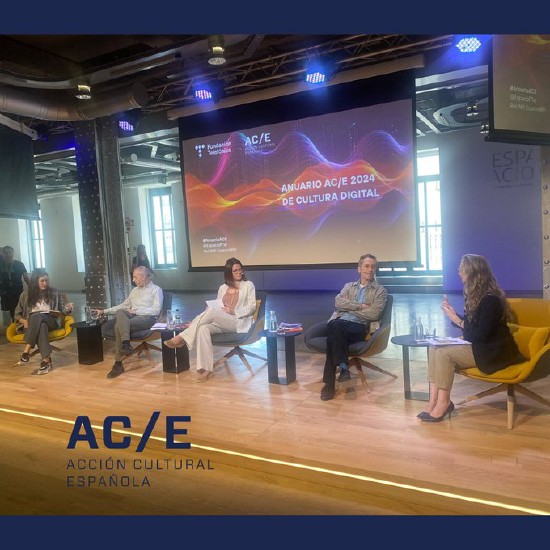
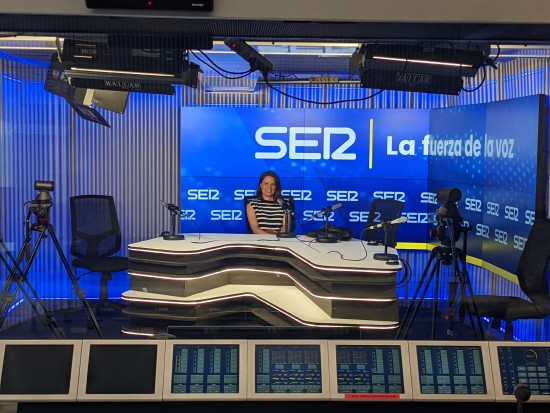
I have organized and participated in a range of science outreach and public engagement activities, such as the Week of Science (2012, 2021 and 2026) and an interview for the popular science magazine QUO. I have also participated in a radio show on La Ventana, Cadena SER, and in a roundtable on fake news and misinformation organized by the Agencia Estatal de Investigación. In addition, I have written an article for The Conversation. Four of my publications, including my thesis, are mentioned in the Best Practice Manual for the Methodology of Forensic Speaker Comparison, published by the European Network of Forensic Science Institutes.
Industry
I worked as linguistic consultant (2018-20) at the technological company Defined.ai, in several projects aimed at improving the quality of machine learning systems, which led to the signature of a transfer contract (“Artículo 83”) with UNED from 2021 to 2023.
Training of early-career researchers
I have supervised undergraduate and master’s theses at UNED and the Complutense University of Madrid. Since 2024, as a Tenured Scientist at the CSIC, I have supervised four JAE-Intro students and a PhD student in the MOMENTUM programme. I have also contributed to the career development of my first JAE-Intro student, who currently holds a research and development technical staff contract.
Interests
- Applied Linguistics
- Experimental Phonetics
- Forensic Phonetics
- Clinical Phonetics
- Sociolinguistics
- Computational Linguistics
Education
-
PhD in Speech Sciences, 2014
Spanish National Research Council (CSIC), Madrid, Spain
-
MSc in Quantitative Research Methodology & Statistics Techniques, 2010
Statistics Laboratory, Higher Technical School of Industrial Engineering, Polytechnical University of Madrid, Spain
-
MA in Phonetics & Phonology, 2009
Spanish National Research Council (CSIC), Madrid, Spain
-
BA in Hispanic Studies, 2008
University of Salamanca, Spain
-
BA in English Studies, 2007
University of Salamanca, Spain